Day trips
Around Santiago de Compostela: the Ulla valley and nearby day trips
Almost everything in this guide is within two hours of the cathedral. Here is what is within one.
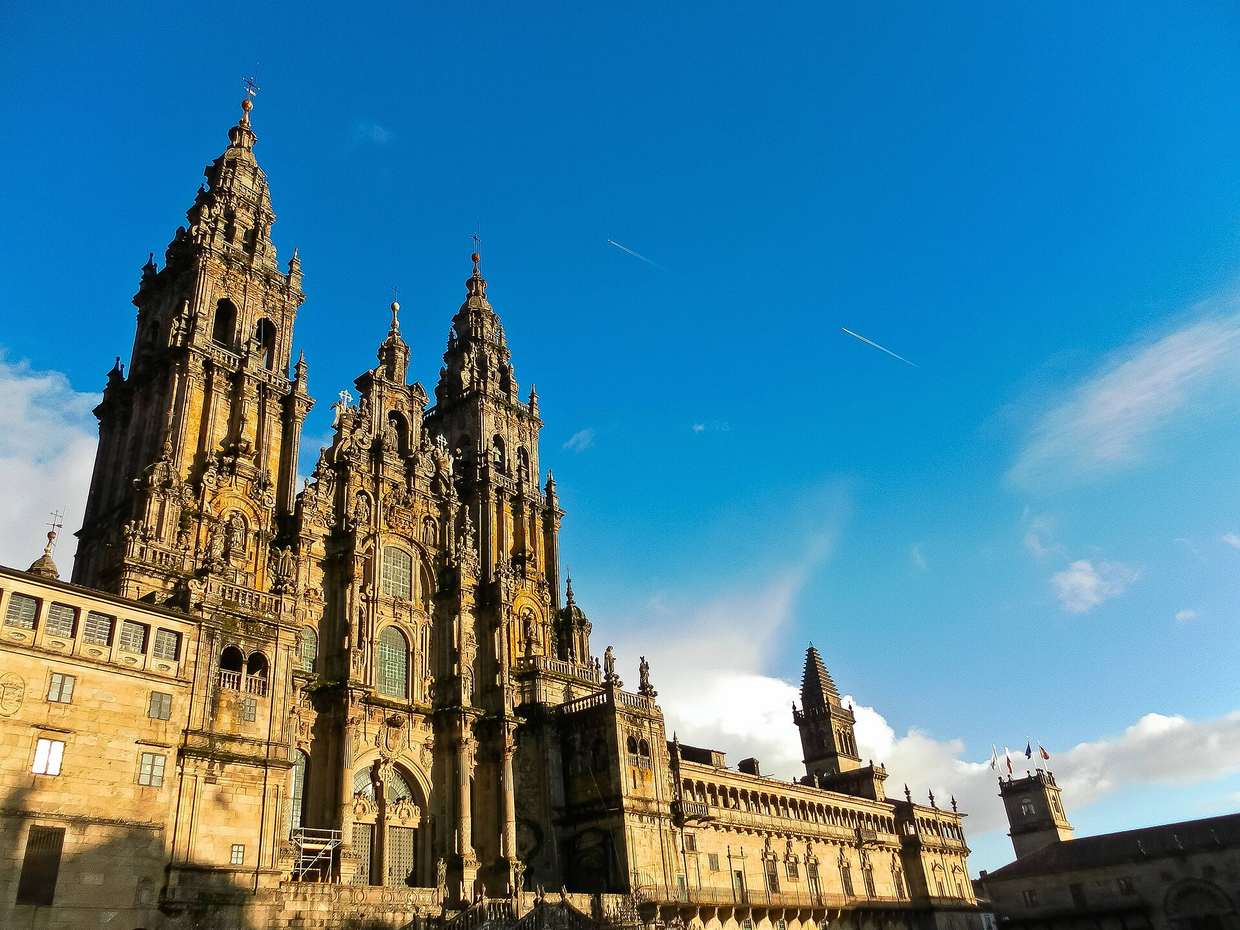
Fotografía: D.Rovchak, CC BY-SA 4.0, vía Wikimedia Commons.

South: the Ulla valley
Fifteen kilometres out, the river Ulla marks the boundary between the provinces of A Coruña and Pontevedra. For centuries it also separated two seigneurial jurisdictions, which is the real reason manor houses cluster thickly along both banks. The valley is planted with albariño and is the Ribeiras do Ulla wine subzone.
The southern pilgrim routes — the Vía da Prata from Ourense and the Portuguese Way from Tui — cross the river here and climb gently into the city. It makes a good half day: a stretch of the route on foot, a vineyard, and one or two of the houses along it: the Pazo de Oca at A Estrada, whose garden is the most elaborate in Galicia and opens all year, or the Pazo do Faramello at Rois, built around an eighteenth-century paper mill. The full provincial lists are under A Coruña and Pontevedra.
West: Noia and the Muros estuary
Forty minutes to the first coast. Noia keeps a medieval core and a churchyard of carved guild gravestones; Muros, further out, has arcaded streets a few metres from the water. This is the quietest of the southern estuaries.
South-west: the Arousa estuary
An hour away, and the centre of gravity for seafood and albariño both. Cambados has the wine and a square that belongs to a much grander town; A Illa de Arousa is reached by a two-kilometre bridge and has a coastal park worth the walk.
How far is too far for one day
A useful rule for Galicia: the map lies about driving time. Distances look short and the roads are slow — river valleys, few straight lines, and villages strung along the route rather than bypassed. An hour of map distance is comfortably ninety minutes in practice, and two hours each way turns a day trip into a drive with a lunch in the middle.
That makes the Ulla valley, the Arousa estuary and the Muros estuary genuine half-days from Santiago, and puts the Ribeira Sacra and the north coast into overnight territory. If the point of the trip is the manor houses rather than the scenery, the densest ground is south and east of the city — the concellos of A Estrada, Arzúa, Melide and O Pino between them hold more catalogued houses than the whole province of Ourense.
Without a car
Trains and coaches connect Santiago to the four provincial capitals reliably. Beyond that the network thins fast: the coastal villages and virtually all the manor houses need driving. The one real exception is the narrow-gauge line along the north coast, which is a long way from Santiago but does link its towns properly.
North: the Ártabro coast
An hour north lie A Coruña and Ferrol, and between them a string of estuaries — Ares, Betanzos, Pontedeume — with arcaded medieval towns at their heads. This is the other concentration of manor houses in the province, mostly rebuilt in the nineteenth century with money made in the Americas, and it is where the camellia gardens are.
East: the Ulla and the Ribeira Sacra
The Lugo list covers this side. Two hours east the Sil cuts a canyon six hundred metres deep, with vineyards terraced down both walls. It is the longest of these trips and the one that least resembles the rest of Galicia: dry, warm in summer, and monastic in its history rather than maritime.
Driving times, realistically
The motorway network along the Atlantic axis is fast, and Santiago to Vigo or A Coruña takes well under an hour. Everything off that axis is slower than the map suggests: the roads into the Ulla valley, the Costa da Morte and the Ribeira Sacra are single carriageway, winding and often behind a tractor. Add half again to whatever the satnav claims for those.
Frequently asked questions
How far is the coast from Santiago?
Around forty minutes west to Noia and the Muros estuary, or an hour south-west to the Arousa estuary. Both are comfortable half-day trips.
Can you see Galicia without a car?
Partly. Trains and coaches link Santiago with A Coruña, Vigo, Pontevedra and Ourense. The villages and the manor houses are another matter, and most need a car.
What is the Ulla valley known for?
Vineyards of the Ribeiras do Ulla subzone, an unusual concentration of manor houses along both banks, and the point where the pilgrim roads from the south cross into the city.